
If you're a researcher reading this, you've probably attended at least three webinars this year about how AI is going to transform your work. The pitch is always the same: AI handles the busywork, you handle the strategy. Everyone moves up the value chain. Standing ovation.
Then you close the webinar and go back to fixing skip logic.
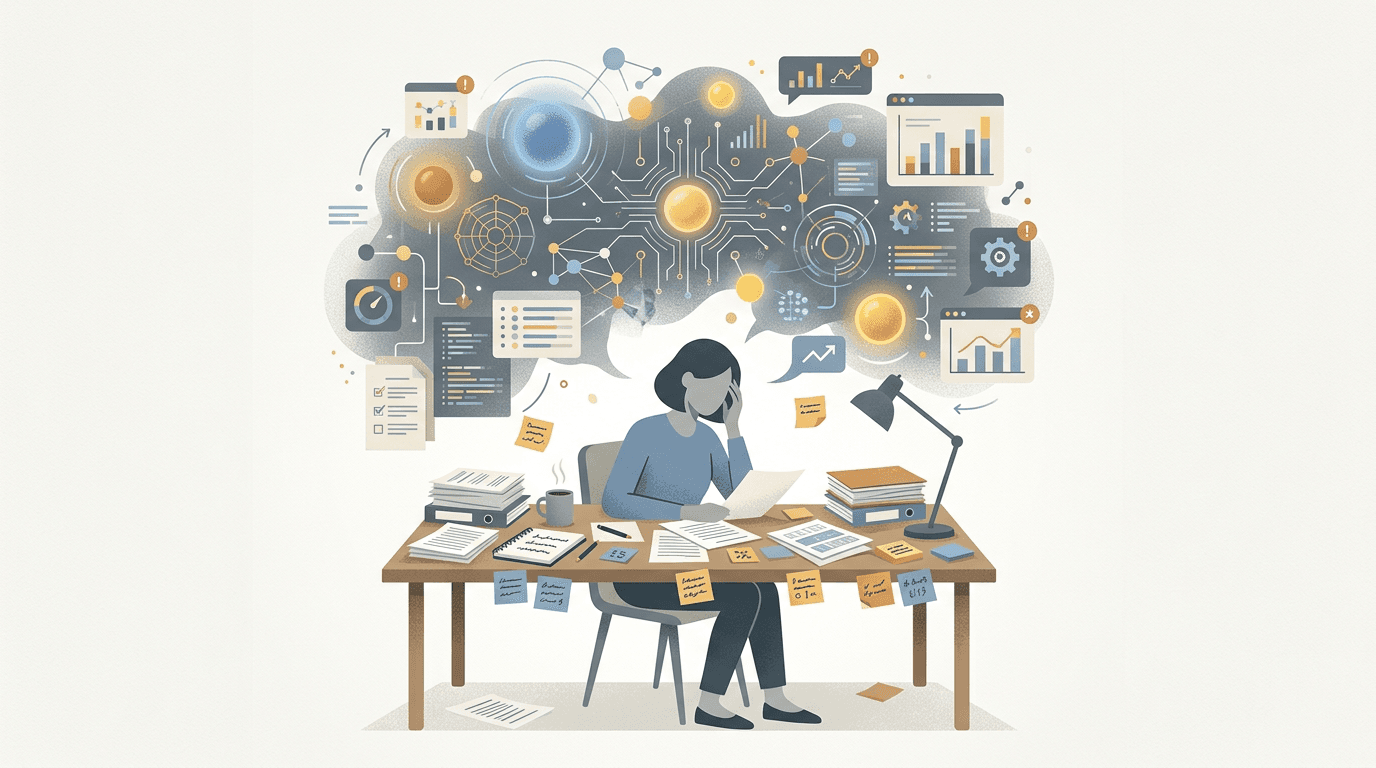
The promise vs. the Tuesday afternoon
The narrative around AI in market research is aspirational and, on its own terms, correct. AI will elevate the researcher's role. AI will free up time for strategic thinking. AI will make insights teams more influential.
But there's a gap between "will" and "has," and researchers are living in it.
A 2026 Qualtrics trends report found that 95% of researchers now use AI tools regularly or are experimenting with them. Adoption is no longer an indicator of innovation — it's table stakes. And yet the day-to-day experience of most researchers hasn't fundamentally changed.
The tools are new. The workload is the same. The deadlines are shorter.
Doing more with less — again
"Do more with less" has been the unofficial tagline of insights teams for a decade. AI was supposed to break the cycle. Instead, it's accelerated it.
Here's what actually happened: AI made certain tasks faster, so leadership raised expectations. If analysis takes half the time, run twice as many studies. If questionnaire design takes an afternoon instead of a week, start fielding tomorrow. The efficiency gains didn't translate to breathing room — they translated to throughput.
Forsta's research on workflow changes puts it bluntly: "With speed comes space for more. More studies, more cuts of data, more summaries, more outputs. Without stronger prioritization, teams and stakeholders can find themselves overwhelmed by insight rather than empowered by it."
The irony is sharp. AI was supposed to reduce cognitive load. For many researchers, it increased it.
The emotional weight
This isn't just an operational problem. It's an identity problem.
Researchers chose this profession because they care about understanding people. They want to design better studies, interpret nuanced findings, tell stories that change business decisions. That's the work that lights them up.
Instead, they spend their days in platform UIs, debugging XML, reformatting cross-tabs, and managing vendor timelines. When someone asks what they do, they don't say "I uncover human behavior" — they say "I program surveys and make PowerPoints."
AI hasn't changed that yet. And the longer the gap persists between what researchers are told AI will do and what it actually does for them today, the more corrosive the frustration becomes.
Where the time actually goes
McKinsey's State of AI research shows that roles adjacent to insights work are already seeing headcount pressure — knowledge management down 16-27%, marketing and sales down 18-32%. Research teams aren't immune to this pressure, but the framing matters.
The question isn't whether AI will change what researchers do. It's which tasks get automated first.
Right now, most AI tools in market research target analysis and reporting — the tail end of the research process. Those are real improvements. But they leave the most time-consuming operational steps untouched:
- Survey programming: 8–12 hours per study, manual, platform-specific
- Link testing and QA: Hours of clicking through every survey path
- Platform-specific deployment: Re-coding the same survey for different clients
- Revision cycles: Rebuilding when the spec changes at the last minute
These are the tasks that keep researchers stuck in execution mode. Until they're automated, "freed up for strategy" is just a conference slide.
What actually helps
The researchers I talk to don't want a chatbot that writes their analysis for them. They want to stop spending two days programming a survey that should take two hours. They want to stop re-testing link logic because a question was reordered. They want their Monday back.
The tools that will actually change a researcher's daily life aren't the ones that generate insight summaries. They're the ones that eliminate the mechanical translation work between a research design and a fielded survey.
That's not glamorous. It doesn't make for a great keynote. But it's what the job actually requires.
The path forward is specific, not general
The 2026 GRIT Business & Innovation Report makes the case that successful research teams are the ones applying AI to specific operational bottlenecks rather than broadly experimenting with general-purpose tools. The differentiation isn't "we use AI" — everyone does. It's "we use AI to solve the exact problem that was costing us the most time."
For most research teams, that problem is programming.
The promise of AI in market research is real. Researchers will become more strategic. Insights will carry more influence. The work will get better.
But the path from here to there runs through the operational layer — the unglamorous, mechanical, time-consuming work that nobody writes keynotes about. Automate that first, and the strategic transformation follows naturally.
Questra exists because we believe the researcher should spend time on research, not translation. If you're tired of the gap between the AI promise and your Tuesday afternoon, upload a questionnaire and see the difference.